

Written and medically reviewed by Colleen Renee, MSN, APRN, FNP-C
Board-Licensed Household Nurse Practitioner / February 11, 2026
A couple of years in the past, a lady in her mid-forties sat throughout from me and stated one thing I’ve since heard a whole lot of instances:
“I don’t really feel sick… I simply don’t really feel like myself anymore.”

She instructed me she had already finished what she was “supposed” to do. She cleaned up her food plan. She exercised commonly. She went to mattress sooner than she ever had in her thirties. Her labs have been “principally regular.” And but, each day felt like she was pushing her physique by moist cement. By mid-afternoon, her mind felt foggy. By night, she was fully depleted.
When she introduced this as much as her physician, the responses have been acquainted.
“That is simply growing old.”
“You’re most likely careworn.”
“That is regular menopause.”
Nobody might clarify why her vitality had disappeared so instantly—or why it felt so completely different from peculiar tiredness.
By the point she reached my workplace, she wasn’t simply annoyed. She was questioning herself. She puzzled if she was being dramatic. If she had misplaced her resilience. If this was merely what life after 40—or 50, or 60—was presupposed to really feel like.
What troubled her most wasn’t solely the fatigue. It was the quiet sense of being dismissed.
A Sample I See Once more and Once more
I hear variations of this story from many ladies:
- Just lately retired lecturers who assumed their exhaustion would enhance as soon as work stress ended—however it didn’t
- Caregivers of their 50s and 60s who really feel drained past what their circumstances alone can clarify
- Girls properly previous menopause who say, “I believed I’d really feel higher by now—why do I nonetheless really feel so drained?”
Some are in perimenopause. Others are years and even a long time postmenopausal. What they share just isn’t a analysis, however a sense: their vitality not behaves the way in which it used to, and nobody has given them a satisfying clarification for why.
As a nurse practitioner, I see this sample repeatedly. Succesful, engaged girls start to really feel disconnected from their very own our bodies. Their signs don’t match neatly right into a single analysis, in order that they’re usually minimized, normalized, or defined away.
What’s necessary to grasp is that this type of fatigue just isn’t random—and it’s not a personality subject. It’s not laziness, lack of grit, or failure to “sustain.” It’s a physiological sign that the physique is present process actual, measurable change.
Menopause Is Extra Than Sizzling Flashes
When most individuals consider menopause, they consider sizzling flashes, evening sweats, and the top of menstrual cycles. However for a lot of girls, the earliest and most disruptive modifications have little to do with temperature or durations.
Among the quiet clues that hormonal transition is affecting vitality embody:
- Sleep that turns into lighter, extra fragmented, or much less restorative
- New or worsening anxiousness, particularly at evening
- Slower restoration from train or each day exertion
- Feeling “wired however drained”
- Afternoon crashes that didn’t used to occur
- Mind fog or diminished psychological stamina
- A way that stress prices greater than it used to
These shifts usually start throughout perimenopause—however they don’t essentially finish as soon as menopause is full. For a lot of girls, fatigue continues into postmenopause and later life, particularly if underlying contributors are by no means addressed.
This Might Be Affecting You—Even If You Assume You’re Previous Menopause
Should you’re studying this in your 40s, 50s, 60s, or past and considering, “I assumed this was simply getting older,” you’re not alone. Many ladies consider persistent fatigue is just the value of growing old—one thing to just accept fairly than look at.
However growing old alone doesn’t clarify why vitality drops instantly, why restoration slows dramatically, or why sleep not restores you the way in which it as soon as did.
The hormonal transition of menopause modifications how the physique regulates vitality, stress, sleep, metabolism, and irritation. When these modifications aren’t supported—at any stage—fatigue usually turns into power.
That doesn’t imply it’s everlasting.
Fatigue is a Warning Sign, Not a Everlasting Flaw
After we cease asking girls to push by exhaustion and begin asking why their vitality programs are struggling, the whole lot modifications. Fatigue turns into info, not a failure.
For a lot of girls in midlife and past, that info factors on to menopause-related modifications—generally lengthy after sizzling flashes have light. And when these modifications are understood, fatigue turns into one thing we will work with, not one thing to endure.
Should you’ve felt unseen, unheard, or instructed that your exhaustion is one thing you merely have to just accept, this text is for you.
As a result of persistent fatigue in midlife and past isn’t one thing to disregard.
It’s one thing to grasp.
In Right this moment’s Article, You Will Be taught About:
- What fatigue actually appears to be like like throughout menopause—and why it’s usually misunderstood or dismissed
- The important thing organic drivers of low vitality throughout hormonal transition
- How menopause disrupts metabolism, mind vitality, sleep, and stress resilience
- The traditional method to menopausal fatigue, and the place it usually falls quick
- A root-cause, menopause-informed method to restoring vitality, step-by-step
By the top of this text, my aim is so that you can higher perceive what your fatigue is telling you—and to really feel empowered with info that helps you progress ahead with readability and confidence.
The Many Shades / Spectrum of Fatigue
Fatigue throughout menopause is usually talked about as if it have been one single expertise—however in actuality, it reveals up in many various types. One of many causes it’s so usually misunderstood or dismissed is as a result of girls don’t all describe it the identical manner.
Some girls expertise bodily fatigue—a heavy, drained feeling within the physique that doesn’t enhance with relaxation. Others wrestle extra with psychological fatigue, marked by mind fog, slowed considering, forgetfulness, or issue concentrating. Many expertise emotional fatigue, the place motivation feels low and even small duties really feel overwhelming.
These kind of fatigue usually overlap, however one could dominate at completely different instances.
A standard sample I hear is morning exhaustion, the place a lady wakes up feeling unrefreshed regardless of a full evening in mattress. Others describe an afternoon crash, usually between 1 and 4 p.m., when vitality drops instantly and dramatically. Some really feel “wired however drained”—bodily exhausted however unable to calm down or sleep, particularly at evening.
One other hallmark of menopausal fatigue is train intolerance. Actions that when felt energizing now really feel depleting. Restoration takes longer. Muscular tissues really feel sore for days. Some girls start skipping exercises not as a result of they lack self-discipline, however as a result of their our bodies merely can’t bounce again the way in which they used to.
Fatigue throughout this stage of life ceaselessly consists of mind fog and motivation loss as properly. Girls could discover it tougher to provoke duties, keep centered, or really feel mentally sharp. This may be particularly distressing for many who have all the time recognized as high-functioning, organized, or mentally pushed.
Like many well being situations, menopausal fatigue exists on a spectrum. On one finish are girls with gentle however persistent low vitality that impacts high quality of life. On the opposite finish are girls whose exhaustion considerably interferes with work, relationships, train, and each day functioning. Even when fatigue doesn’t meet standards for a selected medical analysis, it may possibly nonetheless be deeply disruptive—and significant.
Importantly, fatigue at any level alongside this spectrum can sign underlying physiological stress. It could mirror hormonal shifts, sleep disruption, irritation, nutrient depletion, or modifications in how the physique produces and makes use of vitality. In different phrases, it’s hardly ever “simply in your head.”
Diagnosing Fatigue
One of many challenges with menopausal fatigue is that it’s ceaselessly underdiagnosed and normalized. Many ladies are instructed that feeling drained is just a part of growing old, a busy life, or menopause itself—with out additional investigation into what’s driving the symptom.
Fatigue can be simple to confuse with different situations. It may well overlap with despair, burnout, anemia, thyroid dysfunction, sleep problems, or power stress. Whereas these situations ought to completely be thought of and dominated out when applicable, menopause-related fatigue usually exists even when fundamental labs seem “regular.”
A key distinction is that menopausal fatigue usually follows a sample—worsening with poor sleep, stress, hormonal fluctuations, or overexertion—and doesn’t absolutely resolve with relaxation alone. Many ladies additionally discover that their fatigue coincides with different delicate modifications, equivalent to disrupted sleep, temper shifts, weight redistribution, or modifications in stress tolerance.
There is no such thing as a single check that diagnoses menopausal fatigue. As a substitute, clinicians depend on a mixture of symptom historical past, sample recognition, and focused analysis. Symptom questionnaires, sleep assessments, stress inventories, and hormone or nutrient testing (when applicable) will help construct a clearer image.
Even when fatigue doesn’t meet standards for a proper analysis, that doesn’t imply it ought to be ignored. Subclinical fatigue—fatigue that falls under diagnostic thresholds—can nonetheless impair high quality of life and sign that the physique is struggling to adapt to hormonal transition.
The graphic under summarizes widespread fatigue symptom clusters seen throughout menopause, illustrating how bodily, psychological, and emotional fatigue usually overlap fairly than happen in isolation.
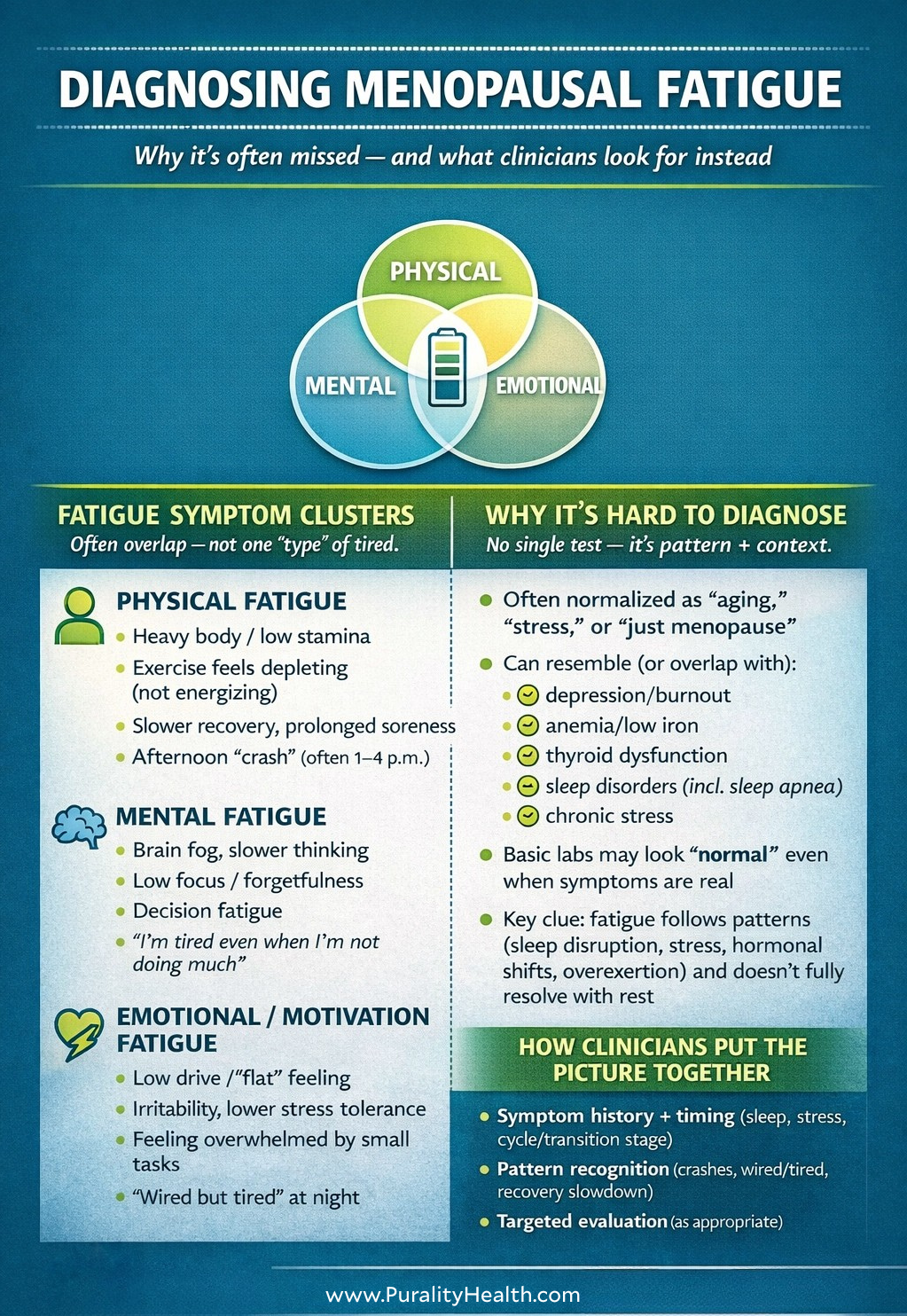
Understanding what fatigue really appears to be like like in menopause is step one towards addressing it successfully. As soon as we acknowledge fatigue as a significant sign—not a private shortcoming—we will start to discover why it’s taking place and what might be finished to revive vitality at its roots.
Menopausal fatigue isn’t pushed by a single subject. As a substitute, it displays a number of overlapping organic modifications that have an effect on how the physique produces, regulates, and conserves vitality.
Beneath, I’ll stroll by the commonest root causes and mechanisms behind fatigue in the course of the menopausal transition.
What Causes Fatigue Throughout Menopause and Past?
Fatigue throughout menopause and life after menopause isn’t attributable to a single subject. As a substitute, it develops when a number of programs that when labored collectively to control vitality, restoration, and resilience start to lose coordination.
Because of this so many ladies really feel confused by their signs. They could repair one piece—sleep, train, food plan—solely to search out their vitality doesn’t absolutely return. That’s as a result of menopausal fatigue displays overlapping organic shifts, not remoted issues.
Beneath, I’ll stroll by the commonest root causes I see in medical apply, clarify how every contributes to fatigue, and describe what these imbalances usually appear to be in actual life.
Hormonal Shifts and Neuroendocrine Disruption
Hormones are sometimes mentioned in menopause, however their function in vitality regulation is ceaselessly oversimplified. Whereas estrogen decline will get essentially the most consideration, fatigue is extra precisely defined by how a number of hormones change—and the way their timing and interplay impacts the nervous system.
Estrogen vs. Progesterone Timing in Perimenopause
One necessary element that’s usually missed is that progesterone sometimes declines sooner than estrogen throughout perimenopause.
Progesterone has a chilled impact on the mind. It helps GABA signaling, which promotes rest, sleep initiation, and nervous system stability. When progesterone drops first, girls could discover:
- hassle falling or staying asleep
- elevated anxiousness or restlessness
- feeling “wired however drained”
- early morning waking
These signs can seem years earlier than durations cease—and lengthy earlier than sizzling flashes start. Sleep disruption alone can considerably drain vitality reserves, making fatigue one of many earliest indicators that hormonal steadiness is shifting.
Estrogen, in the meantime, helps:
- mitochondrial effectivity
- glucose uptake into cells
- cerebral blood circulate
- serotonin and dopamine steadiness
As estrogen fluctuates and ultimately declines, vitality manufacturing turns into much less environment friendly at each the mobile and neurological ranges. When progesterone-related sleep disruption and estrogen-related vitality inefficiency overlap, fatigue can escalate shortly.
What this usually appears to be like like clinically:
A girl in her late 40s reviews sleeping “okay” however waking unrefreshed, feeling anxious at evening, and dragging by the day—regardless of regular labs and no clear analysis.
Cortisol Rhythm Disruption and the “Wired however Drained” Sample
Cortisol is the physique’s major stress hormone, and it follows a each day rhythm. Ideally, cortisol rises within the morning to advertise alertness, then regularly declines all through the day to permit for sleep at evening.
Throughout perimenopause and postmenopause, this rhythm usually turns into disrupted.
Some girls develop elevated nighttime cortisol, which contributes to:
- issue falling asleep
- frequent nighttime waking
- racing ideas at evening
Others develop flattened cortisol rhythms, the place cortisol is low within the morning and doesn’t rise appropriately—resulting in:
- morning exhaustion
- low motivation
- reliance on caffeine
- afternoon crashes
This dysregulation taxes the nervous system and makes vitality really feel fragile and unpredictable.
What this usually appears to be like like clinically:
A girl feels exhausted all day however instantly alert at evening, struggles to wind down, and wakes up already drained—regardless of spending sufficient time in mattress.
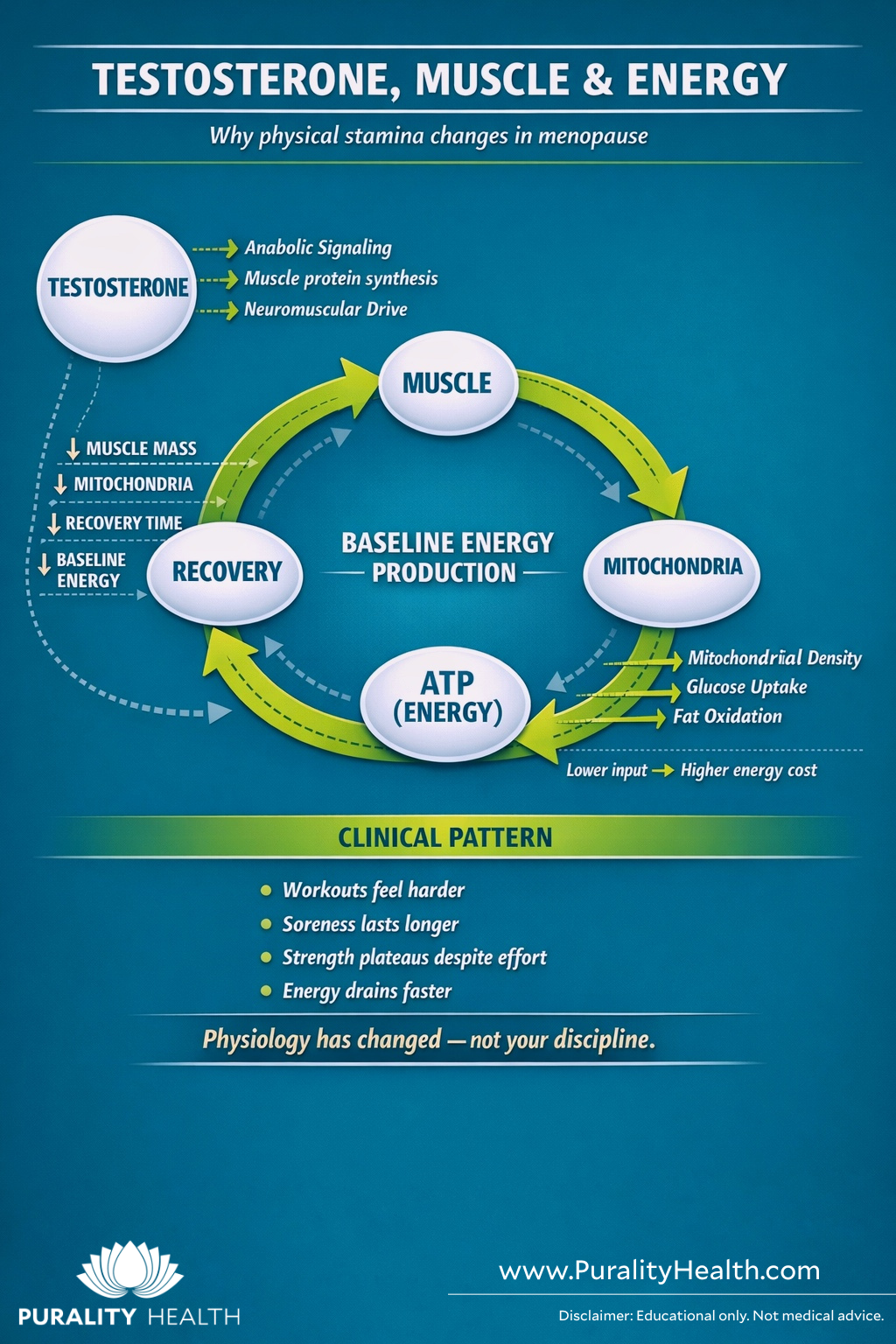
Testosterone, Muscle Mass, and Baseline Power
Testosterone performs a significant function in girls’s vitality, but it’s usually missed.
In girls, testosterone helps:
- muscle mass and power
- bodily stamina
- motivation and drive
- restoration from train
As testosterone ranges decline with age, girls could discover:
- diminished train tolerance
- slower restoration
- lack of muscle tone
- decreased baseline vitality
This contributes to the sensation that “the whole lot takes extra effort” and that bodily exercise is not energizing.
What this usually appears to be like like clinically:
A girl who has exercised persistently for years instantly feels worn out by exercises that when felt manageable, with extended soreness and diminished motivation.
Irritation and Immune Activation
Low-grade, power irritation is without doubt one of the most underappreciated drivers of fatigue in midlife and past.
Inflammaging and Menopause
As we age, the immune system tends to turn out to be extra inflammatory—a course of generally known as inflammaging. Menopause can amplify this course of as a result of estrogen has pure anti-inflammatory results.
As estrogen declines:
- inflammatory signaling molecules (cytokines) improve
- oxidative stress rises
- tissue restore slows
Irritation immediately impacts the mind, producing signs usually described as:
- fatigue
- low motivation
- mind fog
- emotional flatness
This isn’t psychological—it’s a organic response.
How Irritation Drains Power
Irritation:
- impairs mitochondrial vitality manufacturing
- interferes with neurotransmitter signaling
- disrupts sleep structure
- worsens insulin resistance
Every of those results compounds fatigue, even when way of life habits seem “wholesome.”
What this usually appears to be like like clinically:
A girl eats properly and workout routines reasonably however feels persistently infected, achy, foggy, and exhausted—particularly after stress or poor sleep.
Neurotransmitters and Mind Power
Power is not only bodily—it’s neurological.
Neurotransmitters regulate motivation, focus, alertness, and perceived vitality. Throughout menopause and later life, these programs turn out to be extra delicate to disruption.
Dopamine and Motivation Loss
Dopamine drives motivation, reward, and psychological vitality. When dopamine signaling is impaired, duties really feel tougher to start out—even when want and self-discipline are current.
Because of this motivation loss throughout menopause is usually mistaken for laziness or burnout.
Sleep deprivation, irritation, insulin resistance, and estrogen decline all impair dopamine signaling.
Serotonin, Norepinephrine, and GABA
- Serotonin impacts temper, sleep high quality, and perceived vitality
- Norepinephrine helps alertness and focus
- GABA promotes calmness and restorative sleep
When these programs fall out of steadiness, girls could really feel:
- mentally exhausted
- emotionally flat or irritable
- overstimulated but depleted
Alcohol, Late Consuming, and Neurotransmitter Disruption
Alcohol and late-night consuming—each extra impactful with age—can considerably disrupt neurotransmitter steadiness by:
- fragmenting sleep
- growing nighttime cortisol
- impairing serotonin and GABA signaling
Even small quantities can have outsized results in later life.
What this usually appears to be like like clinically:
A girl notices that one glass of wine now ruins her sleep and worsens fatigue the following day—one thing that didn’t occur in her 30s.
That is additionally the place foundational nutrient assist turns into necessary.
B nutritional vitamins, vitamin D3 with K2, magnesium, and different cofactors play essential roles in neurotransmitter synthesis and sleep regulation. When a number of programs are beneath pressure, some girls discover it useful to make use of a complete menopause-focused method—equivalent to MenoPlus—to assist these pathways collectively fairly than chasing particular person deficiencies one after the other.
Intestine Microbiome Alterations
The intestine has a profound affect on vitality—and menopause modifications the intestine ecosystem.
The Estrobolome and Estrogen Recycling
The estrobolome refers to intestine micro organism concerned in metabolizing and recycling estrogen. When intestine steadiness shifts:
- estrogen clearance could turn out to be inefficient
- circulating estrogen patterns turn out to be much less steady
- irritation can improve
These modifications can have an effect on vitality, temper, and digestion.
Quiet Intestine Dysfunction
Not all intestine points trigger digestive signs. Many ladies with fatigue have:
- diminished nutrient absorption
- elevated intestine permeability
- low-grade endotoxin publicity
All of which improve irritation and drain vitality—with out apparent GI complaints.
What this usually appears to be like like clinically:
A girl reviews fatigue and mind fog however denies bloating or digestive points. Testing later reveals nutrient insufficiencies linked to poor absorption.
Mitochondrial Dysfunction and Oxidative Stress
Mitochondria are the cell’s vitality producers, and their operate declines with age and hormonal change.
Estrogen helps mitochondrial biogenesis and antioxidant defenses. As estrogen fluctuates and declines:
- ATP manufacturing turns into much less environment friendly
- oxidative stress will increase
- restoration from exertion slows
The “Power Funds” Idea
Consider vitality as a finances. After 40, the price of stress, train, poor sleep, and irritation will increase—whereas vitality manufacturing turns into much less environment friendly.
Because of this many ladies can not “push by” fatigue with out penalties.
Why Overtraining Backfires
Excessive-intensity, high-frequency train with out enough restoration:
- will increase irritation
- strains mitochondria
- worsens fatigue
This doesn’t imply girls ought to cease transferring—it means the dose and sort of motion matter greater than ever.
Preview of Mitochondrial Assist
Sure vitamins are essential for mitochondrial operate, together with:
- CoQ10
- L-carnitine
- N-acetyl cysteine (NAC)
We’ll talk about these in additional element later, however that is the place many ladies start to note actual enhancements in stamina and restoration.
Because of this some girls do finest with complete assist that targets a number of pathways directly.
Quite than addressing irritation, mitochondrial operate, and nutrient depletion individually, a multi-ingredient method like MenoPlus can function a foundational layer whereas different way of life and dietary modifications are applied.
Genetics and Epigenetics (Temporary however Essential)
Genetics affect how resilient—or susceptible—a lady is to hormonal change.
Some girls have genetic variations affecting:
- detoxing
- antioxidant capability
- vitality metabolism
- stress response
However genes aren’t future.
Epigenetics—how way of life, stress, sleep, and vitamin affect gene expression—performs a serious function. Power stress and nutrient depletion can “flip up” fatigue pathways, whereas focused assist can quiet them.
Frequent Fatigue Patterns I See in Girls After 40
- Postmenopause, “excellent labs,” persistent fatigue:
A girl in her early 60s with regular labs, poor sleep, and a each day afternoon crash—in the end linked to cortisol rhythm disruption and low magnesium/B nutritional vitamins. - Late-life caregiver fatigue:
A girl caring for an growing old dad or mum, skipping meals, low protein consumption, power stress—fatigue pushed by blood sugar instability and nutrient depletion. - Gymnasium-goer with new train intolerance:
A girl who continues high-intensity exercises however experiences extended soreness and exhaustion—mitochondrial overload and insufficient restoration. - Mind fog with low ferritin/B12:
A girl with psychological fatigue and poor focus regardless of “regular” labs—later discovered to have low-normal iron and B12 impacting mind vitality.
Fatigue throughout menopause and past just isn’t a private failure. It displays actual, interconnected organic modifications. Understanding these mechanisms is step one towards restoring vitality—not by forcing the physique to carry out, however by supporting it within the methods it now wants.
Why Power Loss Turns into Extra Probably—and Extra Persistent—After 40
By now, it ought to be clear that fatigue during menopause and beyond is not caused by a single hormone shift or lifestyle mistake. What makes this stage of life uniquely difficult is that a number of protecting programs change on the similar time—usually quietly, and sometimes with out apparent lab abnormalities.
Menopause doesn’t “create” fatigue out of nowhere.
As a substitute, it removes layers of organic buffering that beforehand helped girls tolerate stress, poor sleep, irritation, and metabolic pressure with out noticeable penalties.
This part explores why fatigue turns into extra probably, extra persistent, and tougher to bounce again from after menopause—and why vitality usually feels extra fragile even years later.
Lack of Hormonal Buffering Towards Stress
For a lot of maturity, estrogen and progesterone act as stress moderators. They don’t get rid of stress, however they scale back how expensive it’s to the physique.
These hormones assist:
- Regulate cortisol output
- Defend sleep structure
- Scale back inflammatory signaling
- Assist nervous system flexibility
- Enhance restoration after bodily or emotional pressure
As hormone ranges fluctuate and decline, stress turns into dearer—biologically talking.
What “Lack of Buffering” Actually Means
When hormonal buffering is robust:
- A nasty evening of sleep is annoying—however recoverable
- A hectic week is tiring—however momentary
- Skipping meals or exercises has minimal fallout
After menopause:
- One poor evening of sleep can derail vitality for days
- Emotional stress feels bodily draining
- Restoration takes longer—and generally by no means absolutely occurs
Because of this many ladies say:
“I’m not doing something in another way, however the whole lot feels tougher.”
They’re not flawed. Their physiology has modified.
Medical Sample
Girls usually describe:
- Feeling disproportionately exhausted by emotional stress
- Dropping resilience they as soon as took as a right
- Needing extra downtime than earlier than—and feeling responsible about it
This isn’t psychological weak spot. It’s diminished hormonal shock absorption.
Altered Glucose Utilization and Insulin Sensitivity
One other key motive fatigue emerges throughout menopause and later life is altering glucose dealing with.
Estrogen performs a task in:
- Insulin sensitivity
- Glucose transport into muscle and mind cells
- Mitochondrial gas effectivity
As estrogen declines:
- Cells turn out to be much less aware of insulin
- Blood sugar turns into extra unstable
- Power availability turns into much less predictable
Why This Issues for Power
Even gentle blood sugar instability may cause:
- Morning sluggishness
- Noon crashes
- Mind fog
- Irritability
- “Hangry” fatigue that improves briefly with meals
Importantly, many ladies experiencing this:
- Do not have diabetes
- Have “regular” fasting glucose
- Are instructed blood sugar isn’t the difficulty
However subclinical instability nonetheless drains vitality.
Medical Sample
Frequent complaints embody:
- “I’m exhausted except I eat always.”
- “I really feel shaky or foggy if meals are delayed.”
- “Carbs assist at first, then I crash tougher.”
Stabilizing blood sugar usually produces one of many quickest enhancements in fatigue, particularly when paired with enough protein consumption.
Adjustments in Muscle Mass and Metabolic Charge
Muscle is not only about power—it’s about vitality regulation.
Muscle as an Power Organ
Muscle tissue:
- Shops and makes use of glucose effectively
- Helps mitochondrial density
- Improves insulin sensitivity
- Produces metabolic signaling molecules (myokines)
After menopause:
- Lean muscle mass declines extra quickly
- Metabolic price slows
- Power manufacturing turns into much less environment friendly
This creates a suggestions loop:
Much less muscle → poorer glucose management → extra fatigue → much less exercise → additional muscle loss
Why Train Feels Completely different
Many ladies discover that:
- Exercises really feel tougher
- Restoration takes longer
- Soreness lingers
- Motivation drops
This usually results in exercise avoidance, which worsens fatigue over time—not as a result of train is unhealthy, however as a result of the flawed sort or dose is getting used.
Medical Sample
Girls ceaselessly say:
“I’m doing the identical exercises, however my physique doesn’t reply anymore.”
It is a sign to shift technique, not stop motion altogether.
Biochemical and Metabolic Adjustments That Compound Fatigue
Blood Sugar Instability (Revisited, Deeper Layer)
Blood sugar instability interacts with:
- Cortisol rhythm
- Neurotransmitter manufacturing
- Sleep high quality
- Inflammatory signaling
After menopause, these programs are extra tightly coupled—that means a disruption in a single shortly impacts the others.
Even modest swings can:
- Enhance nighttime cortisol
- Scale back deep sleep
- Impair dopamine signaling
- Enhance perceived fatigue
Because of this many ladies really feel each drained and wired.
Iron, B Vitamin, and Magnesium Depletion
As girls age, nutrient wants usually improve—whereas absorption effectivity declines.
Iron
Even with out anemia, low ferritin can impair:
- Oxygen supply
- Mind vitality
- Mitochondrial operate
That is particularly related for:
- Girls with a historical past of heavy bleeding
- Girls who prevented iron for years
- Girls with restrictive diets
B Nutritional vitamins
B nutritional vitamins are important for:
- ATP manufacturing
- Neurotransmitter synthesis
- Stress metabolism
Low-normal ranges may cause:
- Mind fog
- Low motivation
- Poor stress tolerance
Magnesium
Magnesium helps:
- Over 300 enzymatic reactions
- Muscle rest
- Nervous system regulation
- Sleep depth
Deficiency is extraordinarily widespread and sometimes presents as fatigue + poor sleep + muscle stress.
That is one motive many ladies do higher with complete nutrient formulation that handle a number of depletion factors concurrently, fairly than chasing particular person deficiencies one after the other.
(That is the place a menopause-specific method like MenoPlus can act as a foundational layer fairly than a “magic bullet.”)
Thyroid Operate Adjustments (With out Autoimmune Illness)
Menopause doesn’t trigger autoimmune thyroid illness—however it does have an effect on thyroid operate dynamics.
Estrogen influences:
- Thyroid hormone transport
- Binding proteins
- Mobile uptake
As estrogen ranges change:
- Thyroid hormones could turn out to be much less out there on the tissue degree
- Signs can seem even with “regular” labs
Medical Sample
Girls could expertise:
- Fatigue
- Chilly sensitivity
- Slowed metabolism
- Lowered train tolerance
—and be instructed their thyroid is “nice.”
This mismatch between labs and lived expertise is widespread after menopause.
Sleep Disruption as a Central Power Driver
Sleep is the place vitality is restored. Menopause disrupts sleep in a number of overlapping methods.
Evening Sweats, Insomnia, and Early Waking
Hormonal fluctuations have an effect on thermoregulation and neurotransmitter steadiness, resulting in:
- Evening sweats
- Problem staying asleep
- Early waking with racing ideas
Even when complete sleep time appears to be like enough, sleep high quality is usually poor.
Circadian Rhythm Adjustments
After menopause:
- Cortisol rhythms could invert
- Melatonin manufacturing declines
- Mild sensitivity will increase
This creates a sample of:
- Daytime fatigue
- Night alertness
- Non-restorative sleep
Medical Sample
Girls usually say:
“I’m in mattress lengthy sufficient, however I by no means really feel rested.”
This isn’t a sleep hygiene failure—it’s physiology.
Shared Triggers That Worsen Fatigue (and Shared Options)
One of the vital hopeful elements of menopausal fatigue is that a lot of its drivers overlap—and reply to the identical foundational helps.
Frequent Triggers
- Power psychological stress
- Fragmented sleep
- Inflammatory diets
- Nutrient insufficiency
- Intestine dysfunction
- Overtraining or under-recovery
Why Enhancements Stack
As a result of these programs are interconnected:
- Enhancing sleep stabilizes blood sugar
- Decreasing irritation improves mitochondrial output
- Replenishing vitamins improves stress resilience
- Supporting intestine well being improves absorption and immune signaling
Because of this fatigue usually improves non-linearly—a small change can unlock a number of programs directly.
Many ladies profit from addressing these shared pathways collectively fairly than sequentially, which is why multi-system dietary assist usually outperforms remoted interventions.
(Once more, that is the place a method like MenoPlus suits finest—as a assist for overlapping calls for, not a alternative for way of life modifications.)
Why Fatigue Is Typically the Earliest—and Loudest—Sign
Fatigue ceaselessly seems earlier than:
- Sizzling flashes
- Weight modifications
- Temper signs
- Formal menopause analysis
That’s as a result of vitality programs are sometimes the primary to really feel pressure.
Fatigue just isn’t a nuisance symptom—it’s info.
When vitality drops, the physique is signaling:
“The best way I used to function not works.”
Listening early makes restoration simpler. Ignoring it usually results in deeper burnout later.
Key Takeaways About The Menopause Fatigue Connection
Fatigue throughout menopause and past just isn’t:
- A motivation drawback
- A self-discipline subject
- A standard consequence of growing old poorly
It’s the predictable results of shedding organic buffers that when protected vitality, restoration, and resilience.
The excellent news?
These programs are modifiable.
Within the subsequent part, we’ll look at how typical care sometimes addresses menopausal fatigue—and why so many ladies really feel it falls in need of what they really want.
What It Does Properly—and The place It Typically Falls Quick
Typical medical care performs an necessary function in evaluating fatigue throughout midlife and later life. When finished thoughtfully, it may possibly determine critical situations, present symptom aid, and provide reassurance when applicable. Many ladies profit from this care—particularly when fatigue has a transparent, single trigger.
On the similar time, persistent fatigue associated to menopause and life after menopause usually proves tough to deal with throughout the construction of normal medical visits. Understanding each the strengths and limitations of typical care helps clarify why so many ladies really feel annoyed—or really feel that one thing necessary is being missed.
What Typical Care Does Properly
Ruling Out Critical or Harmful Circumstances
One of the vital priceless elements of typical drugs is its capacity to determine purple flags and rule out situations that require pressing or particular remedy. When a lady presents with fatigue, clinicians appropriately contemplate and consider for:
- Anemia
- Thyroid illness
- Sleep apnea
- Main depressive dysfunction
- Autoimmune illness
- Cardiac or pulmonary situations
- Treatment unwanted effects
This screening is important. Fatigue ought to by no means be dismissed with out first making certain that critical causes aren’t current.
Offering Symptom Reduction
Typical care can be efficient at focusing on dominant signs, significantly when one subject stands out. For instance:
- Sleep drugs could assist extreme insomnia
- Antidepressants could assist when medical despair is current
- Hormone remedy could scale back sizzling flashes and evening sweats that disrupt sleep
For some girls, these interventions meaningfully enhance high quality of life—particularly within the quick time period.
Clear Tips and Threat Consciousness
Typical drugs excels at:
- Utilizing evidence-based pointers
- Monitoring for treatment unwanted effects
- Weighing dangers and advantages conservatively
That is significantly necessary when managing hormone remedy, sleep drugs, or psychiatric medicine.
Why Fatigue Is So Laborious to Deal with in Customary Visits
Regardless of these strengths, menopausal fatigue usually falls right into a grey space that’s tough to deal with in routine care.
Fatigue Is a Nonspecific Symptom
Fatigue doesn’t level to a single analysis. It sits on the intersection of:
- Hormones
- Sleep
- Stress physiology
- Metabolism
- Diet
- Irritation
When labs are “regular,” fatigue might be laborious to justify pursuing additional—particularly when no single irregular worth explains the symptom.
Time Constraints Matter
Most major care visits final 10–quarter-hour. In that window, clinicians should:
- Overview signs
- Examine vitals
- Overview labs
- Tackle preventive care
- Handle drugs
There’s usually little time to discover:
- Sleep high quality past hours slept
- Stress load and restoration capability
- Nutrient insufficiencies on the “low-normal” degree
- Blood sugar patterns
- Train tolerance and restoration
In consequence, care usually focuses on what might be addressed shortly—fairly than what could also be driving fatigue beneath the floor.
Fatigue Is Typically Normalized
As a result of fatigue is widespread after 40, it’s ceaselessly framed as:
- “A part of growing old”
- “Regular menopause”
- “Life stress”
Whereas these statements aren’t fully flawed, they’ll unintentionally shut down additional investigation—particularly when fatigue is persistent or worsening.
Frequent Typical Interventions—and Their Limitations
Reassurance or “Watchful Ready”
Many ladies are suggested to watch signs over time with out particular intervention. Whereas applicable in some instances, this method can depart girls feeling dismissed—significantly when fatigue persists for months or years.
Antidepressants and Stimulants
Antidepressants could assist when fatigue is linked to despair or anxiousness. Nevertheless:
- They don’t right hormonal or metabolic contributors
- Some disrupt sleep structure
- Some trigger daytime sedation or emotional blunting
- Weight modifications could worsen fatigue over time
Stimulants can briefly improve alertness however could:
- Worsen sleep
- Enhance anxiousness
- Additional dysregulate cortisol rhythms
Sleep Medicines
Sleep aids will help provoke or keep sleep, however many:
- Scale back restorative deep sleep
- Trigger next-day grogginess
- Lose effectiveness over time
Girls could sleep longer—however not really feel extra rested.
Hormone Remedy: When It Helps—and When It Might Not
Menopausal hormone therapy (MHT) might be an necessary instrument for some girls, significantly when fatigue is pushed by:
- Extreme sizzling flashes
- Evening sweats
- Profound sleep disruption
In these instances, bettering sleep alone can considerably enhance daytime vitality.
Nevertheless, hormone remedy is not a common resolution for fatigue. Many ladies proceed to expertise low vitality regardless of enough hormone alternative—particularly in later postmenopause—as a result of fatigue usually displays:
- Mitochondrial decline
- Nutrient depletion
- Stress physiology modifications
- Irritation
- Metabolic shifts
When Hormone Remedy Might Not Be Acceptable
Hormone remedy could also be prevented or used cautiously in girls with:
- Sure most cancers histories
- Uncontrolled cardiovascular danger
- Excessive clotting danger
- Restricted symptom burden
Even when applicable, hormone remedy works finest as a part of a broader technique, not as a stand-alone repair.
Why Many Girls Nonetheless Really feel Unhelped
The core limitation of typical care just isn’t lack of understanding—it’s scope.
Fatigue after 40 isn’t attributable to one dominant pathology. It emerges when a number of programs are barely off on the similar time. Typical drugs is designed to deal with:
- Clear diagnoses
- Discrete situations
- Single-system issues
Menopausal fatigue is usually multi-system and subclinical, which makes it tougher to deal with utilizing conventional frameworks.
This doesn’t imply typical care is flawed. It means it’s usually incomplete for this explicit drawback.
Within the subsequent part, we’ll discover a root-cause method—one which builds on the strengths of typical care whereas addressing the interconnected programs that regulate vitality in midlife, postmenopause, and past.
A Higher, Root-Trigger Strategy to Restoring Power in Menopause and Past
Typical care might be useful for ruling out critical issues and easing signs, however persistent fatigue after 40 usually doesn’t reply to a single “repair.” In apply, the ladies who regain essentially the most steady vitality are often those who take a systems-based method: we take a look at hormones and sleep structure and blood sugar and nutrient standing and irritation and restoration capability—then we handle the largest bottlenecks first.
The aim isn’t to “hack” your manner again to your 30-year-old vitality. The aim is to assist your physique produce and maintain vitality reliably—in menopause, in postmenopause, and properly into later life.
Treatment and Hormone Optimization
Menopausal hormone remedy (MHT) when applicable
If sizzling flashes/evening sweats are driving fragmented sleep, MHT generally is a significant lever—as a result of restoring sleep continuity usually restores daytime vitality. The secret is individualization and a transparent aim: Is the first driver vasomotor signs and sleep disruption? If sure, symptom-targeted hormone assist could enhance the fatigue image not directly.
Medical “what this appears to be like like”:
- Fatigue that tracks tightly with evening sweats/awakening
- Sleep is the dominant grievance; daytime vitality improves when nights enhance
- “I really feel like I might operate once more if I might simply sleep”
Estrogen, progesterone, and testosterone issues (in plain language)
- Progesterone is usually the sleep-and-calming story—particularly earlier in perimenopause when progesterone drops first.
- Estrogen influences thermoregulation (sizzling flashes), mind vitality signaling, and glucose dealing with.
- Testosterone issues for vitality, muscle upkeep, motivation/drive, and restoration.
Practitioner perception: when testosterone and lean mass drop over time, girls usually describe fatigue as bodily—“the whole lot takes extra effort”—even when temper is steady and sleep is simply mildly disrupted.
Avoiding one-size-fits-all dosing
Hormonal wants can shift throughout the transition and through the years after menopause. What labored at 52 might not be the fitting match at 62. Reassessment issues. Should you pursue hormone remedy, do it with a clinician who will monitor signs, unwanted effects, and danger elements, not simply purpose for a quantity on paper.
Essential word: Hormone remedy might be life-changing for some girls and never applicable for others. This text is instructional and never an alternative to individualized medical recommendation.
Testing and Monitoring (to search out your “vitality bottlenecks”)
For persistent fatigue, I like testing that solutions a easy query: The place is vitality getting caught?
Core lab classes that usually make clear fatigue after 40
1) Metabolic markers (vitality supply)
- Fasting glucose, fasting insulin, A1C
- Lipids (context for metabolic well being)
2) Nutrient standing (vitality manufacturing supplies)
- Ferritin + iron research (particularly if there was a historical past of heavy bleeding earlier within the transition)
- Vitamin B12
- Vitamin D (25-OH vitamin D)
- Magnesium (RBC magnesium when out there; customary serum magnesium can miss low tissue standing)
3) Thyroid operate (vitality “pace-setter”)
- TSH, Free T4, Free T3
(Thyroid antibodies provided that clinically indicated)
4) Stress physiology (vitality timing)
- In choose instances: diurnal cortisol testing (sample issues greater than “regular” single values)
Practitioner perception: it’s widespread for girls to be instructed “the whole lot is regular,” but their fatigue persists—as a result of “regular” reference ranges are broad, and fatigue usually reveals up if you’re low-normal, not essentially “irregular.”
Dietary Interventions (fatigue is usually a gas + timing subject)
Swap to an anti-inflammatory, energy-stabilizing sample
You don’t want an ideal food plan. You want a dependable vitality sample.
In apply, essentially the most constant fatigue enhancements come from:
- Protein adequacy (particularly at breakfast)
- Fiber + phytonutrients (greens, legumes, berries, herbs/spices)
- Wholesome fat (olive oil, nuts/seeds, fatty fish when you eat it)
- Hydration + minerals (particularly if sleep is poor or stress is excessive)
Medical “what this appears to be like like”:
- Fewer afternoon crashes inside 1–2 weeks
- Much less “hangry” irritability and mind fog
- Higher exercise restoration with out altering exercises
Take away widespread energy-drainers (with out turning into restrictive)
Frequent culprits that disproportionately worsen fatigue in later life:
- Extremely-processed meals (inflammatory load + urge for food swings)
- Alcohol (sleep fragmentation + next-day fatigue)
- Late-night consuming (sleep high quality + glucose instability)
Medical “what this appears to be like like”:
- “I didn’t understand how a lot one drink affected my sleep till I finished.”
- “After I cease consuming after dinner, I wake much less at evening.”
Enhance blood sugar stability (the “quiet fatigue repair”)
Even with out diabetes, glucose swings can create:
- sudden sleepiness after meals
- shakiness/irritability between meals
- afternoon exhaustion and cravings
Easy methods with excessive payoff:
- Protein-first meals (protein + fiber earlier than starch)
- Constant meal timing
- Balanced snacks provided that wanted (protein/fats/fiber, not simply carbs)
- A 10-minute stroll after meals when attainable
Life-style Modifications (rebuilding resilience and restoration)
Enhance stress resilience (with out pretending stress is elective)
The nervous system turns into much less tolerant of power pressure over time—particularly when sleep is disrupted. It’s necessary to learn how to change your health and workout routine as you age.
Excessive-return interventions:
- Morning daylight publicity
- A wind-down routine that protects sleep timing
- Breathwork or rest practices that scale back nighttime “wired” vitality
- Energy coaching + strolling, with restoration inbuilt
Practitioner perception: many high-functioning girls hold coaching the way in which they did of their 30s, then marvel why they really feel worse. Typically, the repair just isn’t “cease transferring.” It’s change the dose: fewer all-out periods, extra power, extra strolling, extra restoration.
Dietary Supplementation (Proof-Knowledgeable, Menopause-Related)
Beneath are the vitamins I see most frequently within the fatigue image after 40 and into later life. I’ll embody what they do, what the proof suggests, and sensible guardrails.
Security word: dietary supplements can work together with drugs and medical situations. Should you’re on blood thinners, thyroid treatment, diabetes treatment, antidepressants, or you may have kidney/liver illness, coordinate with a clinician.
1) Magnesium (sleep depth, stress tolerance, vitality metabolism)
Why it issues: magnesium is concerned in a whole lot of enzymatic reactions, together with ATP manufacturing and nervous system regulation.
What the proof suggests: In older adults with insomnia, magnesium supplementation has been proven to enhance subjective sleep measures (sleep time, sleep effectivity, sleep onset latency) and will affect related hormones like melatonin and cortisol.
Medical “what this appears to be like like”:
- fewer early-morning awakenings
- much less “drained however wired” at bedtime
- improved muscle rest and restoration
Types usually used: glycinate (gentler), malate (usually favored for vitality/muscle), citrate (can loosen stool)
Typical dose vary utilized in apply: 200–400 mg elemental magnesium/day
Precautions: kidney illness; interactions with sure antibiotics and thyroid meds (timing issues)
2) B Nutritional vitamins (B-complex + B12) (mitochondria + mind vitality)
Why they matter: B nutritional vitamins are core cofactors for mitochondrial vitality pathways and neurotransmitter synthesis. B12 standing specifically can contribute to fatigue and cognitive slowing, even when values are technically “in vary.”
What the proof suggests: B12 deficiency is well-known to trigger fatigue and neurologic signs; many clinicians deal with “low-normal” B12 when signs match, fairly than ready for frank deficiency. (B12 evaluation and interpretation is usually mentioned in medical references and opinions; lab cutoffs can miss purposeful insufficiency.)
Medical “what this appears to be like like”:
- mind fog and low psychological stamina
- feeling depleted after regular duties
- low motivation with intact temper
Most popular types (usually used):
- methylcobalamin or hydroxycobalamin (B12)
- methylfolate as a substitute of folic acid (for folate assist, when applicable)
Precautions: B6 may cause neuropathy at very excessive doses over time (extra just isn’t higher). Should you’re utilizing a B-complex, select one with smart B6 ranges.
The place a complete method will help: when fatigue is multi-factorial (sleep + stress + nutrient cofactors), some girls do higher beginning with a multi-nutrient basis fairly than “chasing” one nutrient at a time—that is one place a menopause-focused method like MenoPlus can match as a base layer (with individualized add-ons as wanted).
3) Vitamin D3 + K2 (muscle operate, immune steadiness, fatigue notion)
Why it issues: low vitamin D standing is related to poorer muscle operate and immune dysregulation, and many ladies report fatigue enchancment when deficiency is corrected.
Proof path: Supplementation seems most useful when ranges are low to start with, and vitamin D standing is routinely assessed by way of 25-OH vitamin D.
Medical “what this appears to be like like”:
- low stamina and “heavy physique” fatigue
- frequent aches, decrease resilience in winter months
Precautions: keep away from extreme dosing with out labs; vitamin D can increase calcium in vulnerable people.
4) EstroG-100® (menopause symptom assist that not directly helps fatigue)
Fatigue is usually “downstream” of different signs—particularly sizzling flashes and sleep disruption.
What the proof suggests: Clinical studies of EstroG-100® have reported enhancements in menopausal (climacteric) signs and quality-of-life measures over multi-week use in postmenopausal girls.
There’s additionally trial proof suggesting enhancements in sizzling flash frequency over shorter time frames.
Medical “what this appears to be like like”:
- fewer nighttime disruptions → higher daytime vitality
- much less “temperature-driven” waking
How to consider it: this isn’t a stimulant; it’s higher considered as a symptom-support instrument which will assist sleep and luxury—two main fatigue drivers.
5) CoQ10 (mitochondrial output, endurance, restoration)
Why it issues: CoQ10 is a key part of the electron transport chain—your cells’ ATP manufacturing equipment.
Proof path: CoQ10 has been studied throughout fatigue-related situations, with findings that usually level towards improved fatigue metrics and bodily efficiency outcomes in sure teams.
Medical “what this appears to be like like”:
- train intolerance
- gradual restoration after exercises
- “battery drains quick” feeling
Frequent dosing utilized in apply: 100–200 mg/day (some use larger beneath steering)
Precautions: could work together with warfarin; talk about if on anticoagulants.
6) L-Carnitine (fatty acid transport → vitality manufacturing)
Why it issues: carnitine helps shuttle fatty acids into mitochondria for vitality. This will matter extra as metabolic flexibility shifts with age.
Proof path: Trials in older adults have reported enhancements in fatigue-related outcomes in sure contexts.
Medical “what this appears to be like like”:
- low bodily stamina
- fatigue with exercise, not simply sleepiness
Frequent dosing: usually 500–1,500 mg/day relying on type and tolerance
Precautions: may cause GI upset; warning with thyroid situations (talk about with clinician).
7) Omega-3s (irritation modulation, mind vitality)
Why they matter: omega-3 fatty acids affect inflammatory signaling and cell membrane integrity—related for mind operate and restoration.
What the proof suggests: In randomized managed analysis in fatigue contexts (e.g., cancer-related fatigue), omega-3 interventions have been studied for anti-fatigue results, highlighting irritation as a fatigue pathway.
Even when your fatigue just isn’t “medical fatigue syndrome,” the mechanism—decreasing inflammatory load—can nonetheless be related.
Medical “what this appears to be like like”:
- inflammatory “drag” (achy, foggy, drained)
- mood-energy instability with poor sleep weeks
Precautions: higher-dose fish oil can improve bleeding danger in vulnerable people; coordinate if on blood thinners.
8) Selenium (antioxidant protection, thyroid hormone metabolism)
Why it issues: selenium helps antioxidant enzymes and thyroid hormone metabolism. Thyroid operate is deeply tied to perceived vitality.
Proof path: Selenium standing is related to perceived well being and vitality in some observational work; supplementation is usually used to assist antioxidant standing and thyroid physiology, however ought to be appropriately dosed.
Medical “what this appears to be like like”:
- low vitality + chilly sensitivity + sluggishness patterns (particularly when thyroid operate is borderline)
Typical dosing utilized in apply: 100–200 mcg/day
Precautions: selenium extra might be dangerous—keep away from stacking a number of selenium merchandise.
9) Iodine (solely when consumption is actually low)
Why it issues: iodine is required to make thyroid hormone—however each too little and an excessive amount of generally is a drawback.
What authoritative steering emphasizes: Extra iodine (together with high-dose kelp/iodine dietary supplements) can set off thyroid dysfunction in vulnerable people; organizations and opinions warning towards excessive intakes and emphasize higher limits.
For a lot of girls, the fitting first step is a dietary evaluation (iodized salt use, seafood/seaweed consumption, dairy/eggs if consumed) earlier than supplementing.
Medical “what this appears to be like like”:
- fatigue + thyroid-like signs that don’t match labs cleanly
- complement historical past that features high-dose iodine or kelp
Sensible guardrail: keep away from high-dose iodine except supervised; don’t assume extra iodine = extra vitality.
Amino Acids and Mitochondrial Assist (sleep restore + oxidative stress)
Glycine (sleep effectivity and next-day vitality)
What the proof suggests: Managed research have discovered glycine can enhance elements of sleep and next-day efficiency/alertness in some contexts (usually by way of improved sleep effectivity and thermoregulation).
Medical “what this appears to be like like”:
- “I sleep however don’t really feel recovered”
- nighttime restlessness
Precautions: begin low; talk about in case you have advanced medical points.
NAC and Taurine (antioxidant and nervous system assist)
NAC helps glutathione manufacturing; taurine helps mobile stability and calming neurotransmission. The proof base varies by situation, however mechanistically these might be helpful when oxidative stress and poor restoration are distinguished (particularly alongside foundational food plan/sleep work).
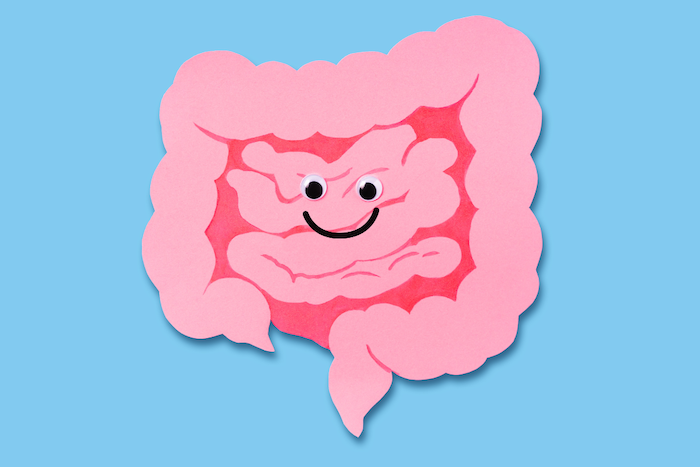
Intestine Well being Assist (as a result of fatigue isn’t all the time “a intestine symptom”)
If the intestine microbiome shifts and absorption suffers, fatigue can present up earlier than bloating or ache.
- fatigue + new meals sensitivity patterns
- low ferritin/B12 tendencies
- irritation markers drifting upward
Assist usually begins with:
- fiber range
- protein adequacy
- simplifying reactive meals
- focused probiotics when applicable
(If you would like, we will add an inside “intestine well being” companion article hyperlink right here later.)
Extra Supportive Interventions
Curcumin (inflammatory fatigue assist; postmenopause information)
What the proof suggests: A double-blind randomized managed trial in postmenopausal girls has investigated curcumin’s results on fatigue and musculoskeletal outcomes, supporting its relevance to fatigue in later life.
Broader meta-analytic work additionally suggests curcumin can scale back fatigue throughout a number of trials.
Medical “what this appears to be like like”:
- inflammatory fatigue (achy + drained)
- stiffness plus low vitality
Precautions: interactions with anticoagulants; GI upset in some.
Adaptogens (when stress physiology is a serious driver)
Ashwagandha: NIH’s skilled truth sheet summarizes trials suggesting ashwagandha can scale back stress/anxiousness and will scale back sleeplessness/fatigue in some adults, usually alongside cortisol reductions.
That is most applicable when the fatigue image consists of stress reactivity and sleep disruption.
Hemp Oil / CBD (adjunct for sleep and nervous system regulation)
For some girls, sleep is the primary bottleneck—particularly waking at evening and never returning to restorative sleep.
What the proof suggests: A randomized trial has examined CBD for insomnia (150 mg vs placebo), reflecting rising analysis curiosity, although research sizes are nonetheless comparatively small and outcomes throughout the broader literature are blended.
Medical “what this appears to be like like”:
- hassle staying asleep
- nighttime nervous system “on” feeling
- next-day fatigue from fragmented sleep
Sensible guardrails:
- select respected merchandise with clear third-party testing
- begin low, go gradual
- keep away from combining with sedatives/alcohol
- assessment treatment interactions (CBD can have an effect on drug metabolism)
Make This Sensible (and never overwhelming)
Should you attempt to do the whole lot directly, it’s laborious to know what helped. A root-cause plan is often finest layered:
- Stabilize sleep + blood sugar fundamentals (usually the largest vitality win)
- Right the almost definitely nutrient bottlenecks (magnesium, B nutritional vitamins, vitamin D; iron provided that indicated)
- Add mitochondrial assist if train intolerance/restoration is distinguished (CoQ10, carnitine, glycine/NAC as applicable)
- Think about symptom-specific helps (e.g., EstroG-100®, CBD) after they match the sample
And sure—that is one motive some girls desire beginning with a complete menopause-focused basis fairly than managing 8 separate bottles. If you would like a single baseline layer that targets a number of pathways (nutrient cofactors + menopausal symptom assist), MenoPlus might be positioned as that basis, when you personalize add-ons primarily based in your sample.
Fatigue in life after 40 isn’t solved with a single intervention. However when underlying contributors are recognized and addressed systematically, vitality can enhance—usually considerably.
Within the subsequent part, I’ll distill this info right into a clear, step-by-step fatigue restoration protocol you need to use as a sensible place to begin.
A Menopause-Knowledgeable Information You Can Truly Use
This text lined lots of floor. That’s intentional—as a result of fatigue after 40, in postmenopause, and into later life isn’t attributable to a single subject. However complexity doesn’t should imply confusion.
This part distills the whole lot you’ve discovered right into a clear, sensible protocol you may comply with—by yourself or in partnership with a healthcare supplier. Consider this as a roadmap, not a inflexible prescription.
You do not must do the whole lot directly. Actually, the ladies who enhance most sustainably are often those who begin with the fitting layer—and construct from there.
Step 1: Select Your Beginning Path
(This determines the place to focus first)
Earlier than you dive into labs, dietary supplements, or protocols, it helps to determine which fatigue sample most closely fits you proper now. Use this as a information—not a analysis.
Path A: Low-Grade however Persistent Fatigue
“I operate, however I’m not myself.”
You may acknowledge your self if:
- You get by the day however really feel drained by night
- You rely extra on caffeine than you used to
- Sleep is “okay,” however not deeply restorative
- Train helps generally—however can even backfire
- Labs are principally regular
Main drivers usually embody:
Sleep fragmentation, gentle nutrient insufficiency, stress load, early hormonal shifts
The place to start out:
Foundations first (sleep timing, blood sugar stability, key vitamins)
Path B: Average, Each day Fatigue
“All the pieces takes effort.”
You may acknowledge your self if:
- You wake unrefreshed most days
- Afternoon crashes are widespread
- Mind fog or low motivation interferes with work
- Train tolerance has dropped noticeably
- Stress feels tougher to get better from
Main drivers usually embody:
Hormonal buffering loss, cortisol rhythm disruption, irritation, mitochondrial pressure
The place to start out:
Foundations + focused vitamins + restoration assist
Path C: Extreme or Life-Limiting Fatigue
“That is affecting my high quality of life.”
You may acknowledge your self if:
- Fatigue interferes with work, caregiving, or each day duties
- Sleep is poor regardless of good habits
- Mind fog or low stamina feels fixed
- Train causes extended crashes
- You’ve tried a number of issues with little aid
Main drivers usually embody:
Multi-system overload (sleep + stress + metabolism + nutrient depletion)
The place to start out:
Structured reset, labs, and layered rebuilding—usually with practitioner assist
Essential:
If fatigue is sudden, quickly worsening, or accompanied by unexplained weight reduction, chest ache, shortness of breath, or neurological signs, search medical care promptly.
Step 2: The Two-Week Reset
(For nearly everybody, no matter beginning path)
The aim of the two-week reset is not to repair the whole lot. It’s to cut back noise so your physique can stabilize—and so you may higher see what helps.
Non-Negotiables for 14 Days
Sleep
- Fastened wake time (even after poor sleep)
- Lights dimmed 60–90 minutes earlier than mattress
- No alcohol
- No late-night consuming (end dinner ≥3 hours earlier than mattress)
Gasoline
- Protein-forward breakfast (20–30 g if attainable)
- Common meals (keep away from lengthy fasting if fatigued)
- Hydration with minerals (particularly when you wake at evening)
Motion
- Stroll each day (10–half-hour)
- Energy coaching provided that restoration is sweet
- No “push by” exercises
Stress
- One each day nervous-system downshift (respiratory, stretching, quiet time)
- Scale back pointless commitments if attainable
What Typically Improves First (2-Week Window)
- Fewer nighttime awakenings
- Much less dramatic afternoon crashes
- Slight enchancment in morning readability
- Extra predictable vitality (even when nonetheless low)
If nothing shifts in any respect in two weeks, that’s helpful info—it often means deeper assist is required, not that you just’re “doing it flawed.”
Step 3: Replenish the Foundations
(That is the place many ladies see their first actual positive aspects)
Fatigue after 40 is usually a supplies drawback as a lot as a hormone drawback. If the physique lacks key inputs, vitality manufacturing will stay inefficient.
Core Foundational Vitamins (Typically Useful)
- Magnesium (sleep depth, stress tolerance, muscle restoration)
- B-complex + B12 (mitochondrial and mind vitality)
- Vitamin D3 + K2 (muscle operate, immune steadiness)
- Omega-3 fatty acids (inflammatory fatigue, mind assist)
You do not want to start out the whole lot directly. Many ladies start with magnesium + B nutritional vitamins and layer from there.
Simplified possibility:
If you would like a single, well-designed base fairly than managing a number of bottles, contemplate a complete menopause-focused method like MenoPlus, which mixes foundational vitamins and menopausal assist in a single place.
Warning Field: Complement Stacking
- Keep away from beginning greater than 1–2 new dietary supplements at a time
- Observe sleep, vitality, digestion, and temper
- Extra just isn’t higher—focused is healthier
Step 4: Testing (When Fatigue Persists or Worsens)
Testing isn’t necessary—however it’s usually useful when fatigue doesn’t reply to foundational steps.
Labs That Typically Make clear the Image
Hormonal context (as applicable):
- Estradiol
- Progesterone
- Testosterone (complete or free)
- SHBG
Stress physiology:
- Diurnal cortisol (saliva or urine, when out there)
Vitamins:
- Ferritin + iron research
- Vitamin B12
- Vitamin D (25-OH)
- Magnesium (RBC most popular)
Metabolic markers:
- Fasting glucose
- Fasting insulin
- A1C
Thyroid operate:
Retest Home windows (Basic Steerage)
- Vitamins: 8–12 weeks after modifications
- Hormones: 3–6 months, except signs change quickly
- Metabolic markers: 3–6 months
Be aware:
Signs usually enhance earlier than labs do. Medical response issues.
Step 5: The 30–90 Day Rebuild
(That is the place stamina and resilience return)
As soon as foundations are in place, the physique is healthier in a position to rebuild capability.
Days 30–60: Restore Capability
Focus areas:
- Mitochondrial assist (if train intolerance persists)
- Blood sugar consistency
- Light power coaching (2–3x/week)
- Continued sleep safety
Frequent additions (pattern-dependent):
- CoQ10
- L-carnitine
- Glycine or NAC (for restoration and sleep-dependent restore)
What usually improves right here:
- Train restoration
- Bodily stamina
- Fewer “wipe-out” days
Days 60–90: Construct Resilience
Focus areas:
- Stress adaptability
- Muscle preservation
- Cognitive vitality
- Inflammatory load
Assist could embody:
- Continued foundational vitamins
- Adaptogens (context-dependent)
- Intestine assist if nutrient ranges lag or digestion feels off
Basis reminder:
At this stage, many ladies do finest sustaining a constant base of dietary and menopausal assist. A method like MenoPlus can function that ongoing basis when you fine-tune way of life and add focused helps as wanted.
What Improves—and When (Typical Timeline)
Whereas each girl is completely different, patterns are widespread:
Weeks 1–2
- Sleep high quality begins to shift
- Evening awakenings scale back
- Power turns into extra predictable
Weeks 3–6
- Mind fog begins to carry
- Afternoon crashes soften
- Temper and motivation stabilize
Weeks 6–12
- Bodily stamina improves
- Train restoration shortens
- General resilience will increase
Should you really feel worse after preliminary modifications, that’s a sign—not a failure. It usually means pacing wants adjustment or that an excessive amount of was layered too shortly.
Sensible Checklists
Indicators You’re on the Proper Observe
- You wake much less at evening
- Power is steadier, even when not excessive
- Restoration is bettering
- You are feeling extra “like your self”
Indicators You Must Gradual Down
- New insomnia
- Elevated anxiousness
- Digestive upset
- Fatigue spikes after modifications
Pink Flags to Re-Consider With a Clinician
- Worsening fatigue regardless of 6–8 weeks of constant effort
- New neurological signs
- Unintentional weight reduction
- Persistent shortness of breath or chest ache
A Remaining Phrase on Expectations
Fatigue after 40 isn’t fastened in a weekend. However it’s usually reversible in significant methods when the fitting programs are supported in the fitting order.
You don’t want perfection.
You don’t must “strive tougher.”
You want alignment between your physique’s present wants and the way you assist it.
This protocol just isn’t about forcing vitality—it’s about making vitality attainable once more.
Bringing It Full Circle
Initially of this text, we described a lady who did the whole lot “proper”—she slept, ate properly, exercised, and nonetheless felt exhausted. What in the end modified for her wasn’t extra self-discipline or a brand new productiveness trick. What modified was how her fatigue was understood.
As a substitute of being handled as a imprecise, inevitable a part of growing old, her low vitality was acknowledged as a organic sign. Sleep was protected fairly than sacrificed. Nutrient gaps have been replenished. Stress physiology was revered as a substitute of ignored. Train was recalibrated to assist restoration fairly than drain it. Over time, her vitality didn’t simply return—it grew to become extra predictable, extra resilient, and simpler to maintain.
That consequence just isn’t uncommon. It’s merely unusual in programs that aren’t designed to look beneath the floor.
Fatigue Is Significant—and Treatable
One of the vital necessary messages to remove from this text is that this:
Fatigue in menopause and later life just isn’t random, and it’s not a private failure.
It displays actual modifications in hormones, mind chemistry, metabolism, immune signaling, sleep structure, and mobile vitality manufacturing. When these programs fall out of sync, fatigue is usually the primary—and loudest—sign the physique sends.
Simply as importantly, these programs are modifiable.
When fatigue is approached as a multi-system subject fairly than a single symptom, enchancment just isn’t solely attainable—it’s widespread. For a lot of girls, the shift isn’t dramatic in a single day vitality, however one thing extra priceless: steadier mornings, fewer crashes, clearer considering, higher restoration, and the sensation that vitality is not so fragile.
Work With Your Physique—and Your Care Workforce
This course of works finest when it’s collaborative.
Should you’re working with a doctor, nurse practitioner, or different healthcare supplier, use what you’ve discovered right here to information extra productive conversations. Ask about sleep high quality, cortisol rhythm, iron standing, B nutritional vitamins, muscle loss, and restoration—not simply whether or not labs are “regular.”
And if one thing you strive doesn’t assist, that’s not failure—it’s suggestions. Fatigue is info. The aim is to hear rigorously and reply thoughtfully.
You’re Not Alone in This
Fatigue might be isolating. Many ladies quietly assume they’re the one ones struggling—or that they need to merely be capable to push by.
You’re not alone. And also you don’t should navigate this stage of life with out assist.
Whether or not that assist comes from a clinician, a group, or rigorously chosen assets, restoring vitality isn’t about doing extra—it’s about doing what’s proper in your physiology now.
Thanks for taking the time to learn this. My hope is that this text helped you’re feeling seen, knowledgeable, and extra assured in regards to the subsequent steps you may take.
Warmly,
Colleen Renee, MSN, APRN, FNP-C
A Remaining Invitation
If this text resonated with you, contemplate sharing it with somebody who may want it—or becoming a member of the broader dialog by our group and academic assets.
P.S. Should you’d wish to study extra about complete dietary assist designed particularly for menopause and life past it, you may explore MenoPlus here.
References:
- The North American Menopause Society. The 2022 hormone remedy place assertion of The North American Menopause Society. Menopause. 2022.
- The North American Menopause Society. The 2023 nonhormone remedy place assertion of The North American Menopause Society. Menopause. 2023.
- Maki PM, et al. Sleep disturbances in menopause. Menopause. 2024.
- Baker FC, et al. Sleep and menopause: a story assessment. Menopause. 2018.
- Polo-Kantola P. Sleep issues in midlife and menopause. Maturitas. 2011.
- Prior JC. Perimenopause: the advanced endocrinology of the menopausal transition. Endocr Rev. (assessment)
- Genazzani AR, et al. Neurosteroids, GABA-A modulation, and menopause-related signs. (assessment)
- Schiller CE, et al. Allopregnanolone, GABA, and temper/sleep in reproductive transitions. (assessment)
- Ventura-Clapier R, et al. Estrogens, mitochondria and cardiac/whole-body energetics. (assessment)
- Mauvais-Jarvis F, et al. Estrogen signaling and irritation/immune modulation. (assessment)
- Velarde MC. Mitochondrial decline, oxidative stress, and growing old within the context of estrogen loss. (assessment)
- Woods NF, et al. HPA-axis modifications and cortisol patterns throughout the menopausal transition. (observational/assessment)
- Kalra S, et al. Stress physiology and sleep disruption in peri/postmenopause. (assessment)
- Vreeburg SA, et al. Diurnal cortisol rhythm and sleep/insomnia associations. (research/assessment)
- Mauvais-Jarvis F. Estrogen and metabolic homeostasis/insulin sensitivity. (assessment)
- Carr MC. The emergence of metabolic syndrome with menopause. J Clin Endocrinol Metab. 2003.
- Lizcano F, Guzmán G. Estrogen deficiency and danger of metabolic dysregulation. (assessment)
- Franceschi C, et al. Inflammaging and age-related immune activation. Ann N Y Acad Sci. 2000.
- Furman D, et al. Power irritation in growing old (“inflammaging”). Nat Med. 2019.
- Straub RH. The stress system and irritation—hyperlinks to fatigue. (assessment)
- Papadakis Z, et al. Sarcopenia in menopausal girls: present views. 2025.
- Sipilä S, et al. Menopause and modifications in physique composition and muscle operate. (research/assessment)
- Greendale GA, et al. Lean mass decline and menopause transition. (SWAN-related work)
- Flores R, et al. The estrobolome: intestine microbiome and estrogen metabolism. (assessment)
- Chen KL, et al. Intestine microbiome modifications in peri/postmenopause. (assessment)
- Baker JM, et al. Microbiome–estrogen–irritation connections. (assessment)
- Col NF, et al. Administration of menopause. CMAJ. 2023.
- ACOG. Hormone remedy for menopause (Observe Bulletin/Medical Steerage). (newest)
- USPSTF/main society steering. Hormone remedy for prevention vs symptom remedy. (guideline)
- WHO. Haemoglobin concentrations for the analysis of anaemia and evaluation of severity. (steering)
- Camaschella C. Iron deficiency. N Engl J Med. 2015.
- Tolkien Z, et al. Iron deficiency with out anemia and fatigue outcomes. (systematic assessment)
- O’Leary F, Samman S. Vitamin B12 in well being and illness. Vitamins. 2010.
- NIH ODS. Vitamin B12 Reality Sheet for Well being Professionals. (net)
- ATA/AACE. Hypothyroidism/thyroid testing steering and symptom–lab mismatch discussions. (guideline)
- Abbasi B, et al. The impact of magnesium supplementation on major insomnia in aged: a double-blind placebo-controlled medical trial. J Res Med Sci. 2012.
- Inagawa Okay, et al. Glycine ingestion and sleep high quality/next-day efficiency (managed human research). Sleep Biol Rhythms. 2006/2007.
- Chung DJ, et al. Efficacy and security of EstroG-100® in postmenopausal girls: randomized, double-blind, placebo-controlled trial. Phytother Res. 2012.
- Verma N, et al. Ashwagandha for stress/anxiousness: systematic assessment/meta-analysis (sleep/fatigue-related outcomes in trials). 2021.
- Suraev A, et al. Cannabidiol for power insomnia: randomized managed trial (dose consists of 150 mg arm in some designs). 2022/2023.
- AASM/JCSM. Hashish and sleep: scoping assessment / proof abstract. 2025.
- NIH ODS. Iodine—Well being Skilled Reality Sheet (UL; extra iodine dangers; treatment interactions).
- Institute of Medication (NASEM). Dietary Reference Intakes (DRIs): Calcium, Vitamin D, and associated micronutrients. (for UL framing)
- Holick MF. Vitamin D deficiency. N Engl J Med. 2007.
- Cochrane/main meta-analysis. Vitamin D supplementation and fatigue outcomes (profit strongest when poor). (assessment)
- Mehrpooya M, et al. L-carnitine and fatigue outcomes in adults/older adults (trial information). (trial)
- Systematic assessment/meta-analysis. Coenzyme Q10 and fatigue/bodily efficiency outcomes throughout situations. (assessment)
- Each day JW, et al. Curcumin and fatigue: systematic assessment/meta-analysis. (assessment)
- Randomized trial. Curcumin in postmenopausal girls: musculoskeletal/fatigue-related outcomes. (trial)
- Peppone LJ, et al. Omega-3 vs omega-6 fatty acids and cancer-related fatigue in breast most cancers survivors: randomized trial. (trial)
Trending Merchandise





%20and%20NeuroFuel%20Brain%20Supplement%20and%20Focus%20Supplement%20for%20Memory,%20Motivation,%20Energy%20(45%20ct)&url=https://kgsupplements.com/product/natural-stacks-magtech-magnesium-supplement-triple-blended-100-chelated-magnesium-90ct-and-neurofuel-brain-supplement-and-focus-supplement-for-memory-motivation-energy-45-ct/&media=https://m.media-amazon.com/images/I/513LltkNAvL._SS1024_.jpg)

